We received a response to our inquiry into the Pulaski Stiletto. Angus Patterson, Curator of European Base Metals and Arms and Armour at the Victoria & Albert Museum in England, kindly called it a "slightly bizarre object." Mr. Patterson said the hilt was unusual, although the blade and tang were standard. As to the inscription, it is consistent with late 1700s/early 1800s monograms on silver.
So we learned the stiletto could date to the Revolutionary War, but still no more evidence that it was Casimir Pulaski's. Mr. Patterson also suggested another expert to ask, so stay tuned for another update. Thanks to Mr. Patterson for his help.
Wednesday, June 23, 2010
Tuesday, June 15, 2010
more secrets in bones
Out to unearth skull’s secrets ajc.com
Discovered this article on a cool blog, the Anthropologist in the Attic. Before the mystery of Casimir Pulaski's bones, there was a Spainish friar whose skull may have been found at Fort King George State Park in Darien more than 50 years ago.
Wednesday, June 9, 2010
Pointy Stilettos
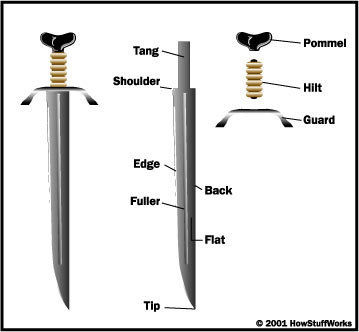
The Coastal Heritage Society recently received a very generous donation. The descendants of Revolutionary War soldier Richard Clough Anderson gave us a small knife, called a stiletto, that is attributed to Casimir Pulaski. Family oral and written histories indicate that a dying Pulaski gave a wounded Anderson his sword (and possibly the stiletto) as they were transported away from the Battle of Savannah.
Pulaski's stiletto?
Richard Clough Anderson fought for independence from January 1776 until the end of the war, serving in several Virginia Regiments. Throughout his six years of service, he was promoted from Captain to Major to Lt. Colonel. According to his pension records, he was in the battles of White Plains and Trenton (1776); Princeton, Brandywine, and Germantown (1777); Monmouth (1778); the Siege of Savannah (1779); the Siege of Charleston (1780) after which he was imprisoned for nine months; and Gloucester and Yorktown (1781). He was wounded once by a lead ball in New Jersey, and a second time by a sabre during the Battle of Savannah. These facts can be established from his pension record (http://www.footnote.com/).
Anderson family histories record even more colorful details. While Anderson was in the hospital with his first wound, he contracted small pox. "Never having any great beauty to spare, on his recovery from this attack, he came out of the hospital with the reputation of being one of the three ugliest men in the American army" (Anderson 1908: 9). He is also reported to be one of the first to surmount Spring Hill Redoubt before being stabbed in the shoulder by Captain Tawes (or Towles) and falling to the base of the trench (Anderson 1908: 10, Anderson 1879:25).
We are in the process of trying to authenticate the stiletto and its oral history. One clue is the engraved letters on each side. The script is beautiful and intricate- but what are the letters?!? Some staff members have seen "A P." Others see "C P."
Anderson's pension record also indicates he had a son, William M. Anderson. I see "WMA" in the photograph above. What letters do you see?
More historical research will also be necessary to document the relationship between Casimir Pulaski and Anderson. Finally, we are looking at the materials and manufacture of the knife itself. Is this stiletto typical of the late 1700s? Are there modern tool marks? Were the letters engraved when the knife was made or were they added later? Only an antique metals expert will be able to determine the answer to these questions.
If anyone has insight into this mystery, please email us at curatorial@chsgeorgia.org.
References Cited:
Anderson, Charles
1908 Ye Andersons of Virginia and some of their descendants.
Anderson, E.L.
1879 Soldier and Pioneer: A Biographical Sketch of Lt. Col. Richard C. Anderson of the Continental Army. G.P. Putnam's Sons, New York.
Monday, May 31, 2010
Before GI's: Original American Soldiers
As I work on Memorial Day, I was thinking about our original American soldiers and sailors who fought in the American Revolution. My favorite being George Washington. But he gets enough press.
I would like to celebrate the soldiers who slogged through the mud but didn't get recognition. Men like Eleazar Phillips, who after being discharged from the militia in Charleston, served aboard the Wasp as a Steward and Purser under Capt. Bulfinch. Historical documents indicate he was present for the death Casimir Pulaski aboard the Wasp after the 1779 Battle of Savannah. After being honorably discharged again, Phillips joined another militia company, serving in the Siege of Charleston. In May of 1780, he was taken prisoner for 12 months.
Phillips served for low, frequently late, pay with no promise of a pension or GI Bill. If the rebels lost.... Well, Ben Franklin said it best at the signing of the Declaration of Independence, "We must all hang together, or assuredly we shall all hang separately."
The pages below are Martha Phillips' 1838 deposition, part of her application for her husband's pension.
Source: footnote.com
Before 1818, pensions were only awarded to officers or those killed or disabled. (Widows could apply for the pensions of deceased servicemen.) The Revolutionary War pensions records are available on footnote.com. These records, mostly from the National Archives, have been scanned and are searchable. Some records are available free of charge, or you can subscribe to have access to all of the records.
I highly recommend browsing through their stash. While old documents can be difficult to read, the software makes it as easy as possible. The stories of the servicemen vibrantly come through the documents. And footnote has documents throughout the entire span on American history, so don't stop at the Revolution!
I would like to celebrate the soldiers who slogged through the mud but didn't get recognition. Men like Eleazar Phillips, who after being discharged from the militia in Charleston, served aboard the Wasp as a Steward and Purser under Capt. Bulfinch. Historical documents indicate he was present for the death Casimir Pulaski aboard the Wasp after the 1779 Battle of Savannah. After being honorably discharged again, Phillips joined another militia company, serving in the Siege of Charleston. In May of 1780, he was taken prisoner for 12 months.
Phillips served for low, frequently late, pay with no promise of a pension or GI Bill. If the rebels lost.... Well, Ben Franklin said it best at the signing of the Declaration of Independence, "We must all hang together, or assuredly we shall all hang separately."
The pages below are Martha Phillips' 1838 deposition, part of her application for her husband's pension.
Source: footnote.com
Before 1818, pensions were only awarded to officers or those killed or disabled. (Widows could apply for the pensions of deceased servicemen.) The Revolutionary War pensions records are available on footnote.com. These records, mostly from the National Archives, have been scanned and are searchable. Some records are available free of charge, or you can subscribe to have access to all of the records.
I highly recommend browsing through their stash. While old documents can be difficult to read, the software makes it as easy as possible. The stories of the servicemen vibrantly come through the documents. And footnote has documents throughout the entire span on American history, so don't stop at the Revolution!
Monday, May 24, 2010
scrubbing without bubbles
I have not posted recently because I have been washing and rebagging artifacts. There isn't much to say about scrubbing tiny bits of ceramics and brick with a toothbrush. Do check out my (mildly) humorous video, "The Dungeon", about the process though.
But while this is not the most exciting part of doing archaeology, it is important. Washing away the dirt allows me to see the details of the object. Doing a preliminary sort while rebagging the clean artifacts makes analyzing the artifacts much easier. Also, I put the cleaned artifacts in special archivally-sound plastic bags. These bags do not give off nasty petrochemicals over time, like ordinary grocery store zip-locks do. These bags are part of how we keep the artifacts safe and preserved for generations, ensuring that future archaeologists will be able to restudy the artifacts. Remember, once an archaeological site is dug, it is gone forever. It is the archaeologists duty to preserve all of the artifacts, field records, maps, photographs, etc... so that the site can be restudied by future archaeologists with better technology. Or the data can be used to compare several similar sites to learn about the bigger picture of human behavior and cultures.
In other news, The Civil War Preservation Trust has announced the 2010 Most Endangered Civil War Battlefields, including Pickett's Mill Battlefield State Historic Site in Georgia. Check out their cool interactive map. Or get involved through donation, becoming a member, or speaking out.
But while this is not the most exciting part of doing archaeology, it is important. Washing away the dirt allows me to see the details of the object. Doing a preliminary sort while rebagging the clean artifacts makes analyzing the artifacts much easier. Also, I put the cleaned artifacts in special archivally-sound plastic bags. These bags do not give off nasty petrochemicals over time, like ordinary grocery store zip-locks do. These bags are part of how we keep the artifacts safe and preserved for generations, ensuring that future archaeologists will be able to restudy the artifacts. Remember, once an archaeological site is dug, it is gone forever. It is the archaeologists duty to preserve all of the artifacts, field records, maps, photographs, etc... so that the site can be restudied by future archaeologists with better technology. Or the data can be used to compare several similar sites to learn about the bigger picture of human behavior and cultures.
In other news, The Civil War Preservation Trust has announced the 2010 Most Endangered Civil War Battlefields, including Pickett's Mill Battlefield State Historic Site in Georgia. Check out their cool interactive map. Or get involved through donation, becoming a member, or speaking out.
Thursday, May 6, 2010
Metal detecting archaeologists
After the disastrous defeat in 1779, the allies fled past two (still present) Jewish Cemeteries where a regiment of Haitian volunteers protected the retreating soldiers. Earlier in the year, we did ground penetrating radar and shovel test pits over several acres of private property around the cemeteries. These property owners generously allowed us to harass them a second time, as we conducted a metal detector survey last week. The results of our survey can be found on the YouTube video, "The Retreat". There is also a two-part interview with Dan Battle, an archaeologist and our metal detector expert/consultant.
I have previously written about our difficulty in finding sites this fieldwork season. I have asked if any citizens out there have found Revolutionary War items in their backyards. (Email photos to curatorial@chsgeorgia.org). No one has responded. So we turned to the people who have found artifacts: the metal detector hobbyists.
Even being in the same room as "evil metal detecting looters" would send some archaeologists running for the hills. I would like to propose a more moderate, central position for both archaeologists and metal detectorists. First, there are many different attitudes among metal detectorists ranging from people who loot and sell artifacts for money to those who only collect on sites about to destroyed by development. Selling artifacts for profit is completely unethical for the professional archaeologist (see the Society for American Archaeology Principles of Archaeological Ethics).
But what about sites that were destroyed and no archaeology was conducted? What if we could recover some information from a metal detectorists who hunted part of the 1779 Battle of Savannah retreat during a construction project? What if that information could be used to find more of the site and ultimately led to more site preservation?
Perhaps metal detectorists and archaeologists could work together on projects where archaeologists supply the methodology and scientific rigor, and detectorists supply the manpower and expertise with their machines. This has been wildly successful on the BRAVO project (Battlefield Restoration & Archaeological Volunteer Organization) which focuses on the Revolutionary War Battle of Monmouth in Freehold, NJ. Dan Sivilich gave an excellent presentation at our 2010 Society for Historical Archaeology conference symposium, Revolutionary Steps: Marching Towards Research and Preservation. His notes are posted on our slideshare site.
Savannah is losing archaeological sites at an alarming, rapid rate. We all care about Savannah's history; let's work together to preserve and protect it. Archaeologists will have to admit that metal detectorists are more knowledgeable in certain areas. Metal detectorists will have to exchange learning new information for keeping bags of useless artifacts. (useless, of course, because they have been pulled out of the context). I think we can find a détente where we can save the last of the Revolution in Savannah.
Disagree with me? Fire away in the comments section.
Tuesday, April 27, 2010
Drinking the YouTube KoolAid
I finally caved and created a YouTube page for Savannah Under Fire, because I have a video and I want to spread the Savannah Under Fire love. You can see us working in Davant Park in this 4 minute video.
Find our YouTube page here. Know it, love it, watch it.
Subscribe to:
Posts (Atom)


